


 Argentina (Español)
 Centroamérica y Caribe (Español)
 Colombia (Español)
 Mexico (Español)
 Uruguay (Español)
 Brasil (Português)
 Region (VETANCO/GLOBAL)
What will animal protein production look like in the coming years?
The answer involves a series of challenges that are already present today: growing demand for food, the need for greater production efficiency, disease control, food safety, animal welfare, sustainability, and the reduction of environmental impacts.
In this context, talking about the future of animal production inevitably means talking about the future of animal health.
And this is precisely where science and innovation take on a central role.
The world will need to produce more, and more efficiently
Projections for the next decade help illustrate the scale of this challenge.
According to the OECD-FAO Agricultural Outlook 2025-2034, global agricultural and fish production is expected to grow by around 14% by 2034. Over the same period, global meat production is projected to increase by 13%, while direct agricultural emissions are expected to rise by 6%. These figures highlight a crucial issue: the carbon intensity of production is decreasing, but the absolute increase in emissions reinforces the need for productivity and sustainability to advance together.
This scenario reflects an important shift in the way production is approached.
Increasing output alone will not be enough.
Production systems will need to become more efficient, productivity will need to improve, and new ways will need to be found to reduce the intensity of the impacts associated with production.
The OECD and FAO themselves point out that productivity gains will be essential to support production growth while limiting increases in emissions.
This is where animal health becomes an essential part of the equation.
Why animal health matters for the future of production
Animal health directly influences the efficiency, productivity, welfare, and safety of production systems.
When disease enters a production system, its effects can extend far beyond the individual animal. It can compromise performance, increase losses, affect profitability, and create impacts throughout the entire production chain.
According to the World Organisation for Animal Health (WOAH), more than 20% of losses in animal production are related to disease. The organization also highlights that investing in animal health contributes to food security, the protection of livelihoods, and the resilience of production systems.
For this reason, prevention, diagnostics, biosecurity, vaccination, nutrition, welfare, and the development of new solutions need to be treated as part of the same agenda.
And that agenda is becoming increasingly science-driven.
Science as a path to new answers
The challenges facing animal production today are complex.
Emerging diseases, antimicrobial resistance, climate change, consumer expectations, and the need to produce food more efficiently all require increasingly specialized knowledge.
Antimicrobial resistance is one example.
In 2026, the FAO published an economic assessment indicating that, if current trends continue, antimicrobial use in livestock production could increase by nearly 30% by 2040 compared with 2019. The report reinforces the need to rethink production strategies and seek alternatives capable of protecting productivity and animal health without increasing long-term risks.
Challenges like this cannot be solved with a single answer.
They require research.
They require experimentation.
They require collaboration.
And they require turning scientific knowledge into practical solutions.
Innovation does not happen in isolation
One of the defining characteristics of modern science is its ability to connect different areas of knowledge.
In animal health, this means bringing together researchers, universities, research centers, companies, technical professionals, producers, and agribusinesses.
In practice, collaboration can accelerate discoveries, expand research capabilities, and bring science closer to the real challenges of production.
This approach has been part of Vetanco’s journey.
The company maintains partnerships with universities and international research centers and develops solutions across different areas of animal health. Today, Vetanco is present in more than 40 countries, has more than 500 employees with academic and scientific backgrounds, and offers a portfolio of more than 200 products.
Among the examples of this approach are initiatives built through scientific collaboration.
BV Science, created through the partnership between Vetanco and Dr. Bata, emerged from the integration of teams and research and development capabilities.
Bioinnovo, meanwhile, was created through the partnership between Vetanco and INTA, bringing together public and private research to develop animal health solutions.
These initiatives reflect the same principle: major challenges can lead to new answers when different forms of expertise work together.
From the laboratory to the field
Research only reaches its full potential when it can be put into practice.
That is how innovation moves beyond discovery and begins to create real impact.
In animal production, this means developing solutions that make sense under real field conditions, contribute to animal health and welfare, and support increasingly efficient and sustainable production systems.
It is a bridge that needs to work in both directions. Challenges in the field help guide new questions for science, and science gives the field new tools to address those challenges.
This connection between People, Research, and Products is part of Vetanco’s DNA.
1. People, because they are the ones who experience the challenges, ask questions, conduct research, and build relationships.
2. Research, because it expands knowledge and opens up new possibilities.
3. Products, because they bring science to life and turn innovation into practical solutions.
What does it mean to reshape the future of animal health?
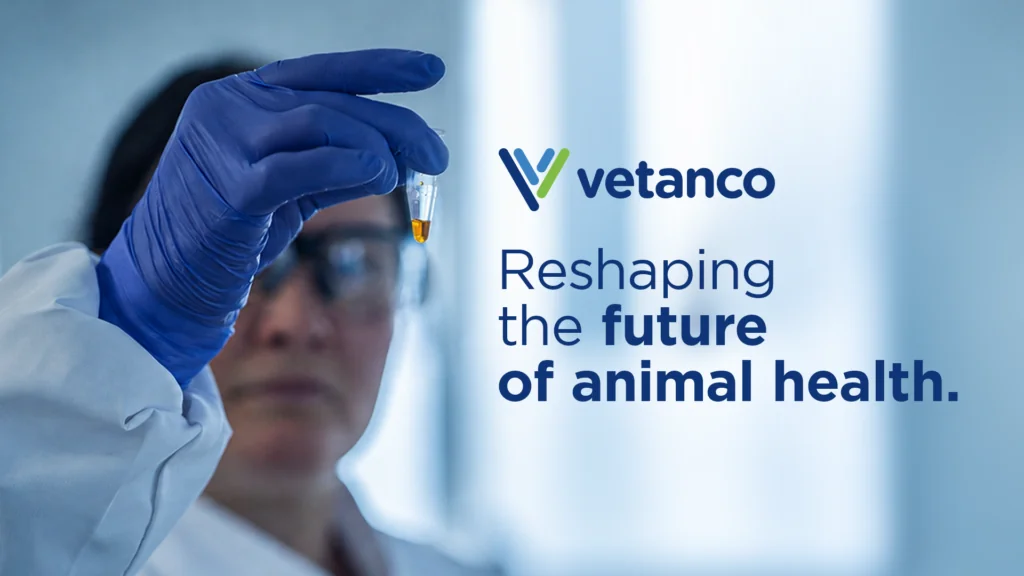
It is within this context that Vetanco’s tagline takes on its full meaning: Reshaping the future of animal health. It is not simply a statement about tomorrow. It is a way of expressing what we are doing today.
To reshape means searching for new answers. It means investigating what we do not yet know. It means turning knowledge into solutions. It means connecting science with experience. It means collaborating so that innovation can go further.
And the future is not only what is yet to come. It is also what begins to be built today.
Every research project. Every partnership. Every discovery. Every solution applied in the field. Every decision that contributes to healthier, more efficient, and more sustainable animal production.
The future of animal health will be shaped by many choices and by many people working to respond to the challenges we already know and those that are still to come.
For Vetanco, being part of that future means continuing to connect science, innovation, and people to turn complexity into practical answers.
Vetanco. Reshaping the future of animal health.
 All
 by
